| population | 1,094,779 peoples |
|---|---|
| area | 786.38 km² |
| population density | 1,392 peoples/km² |
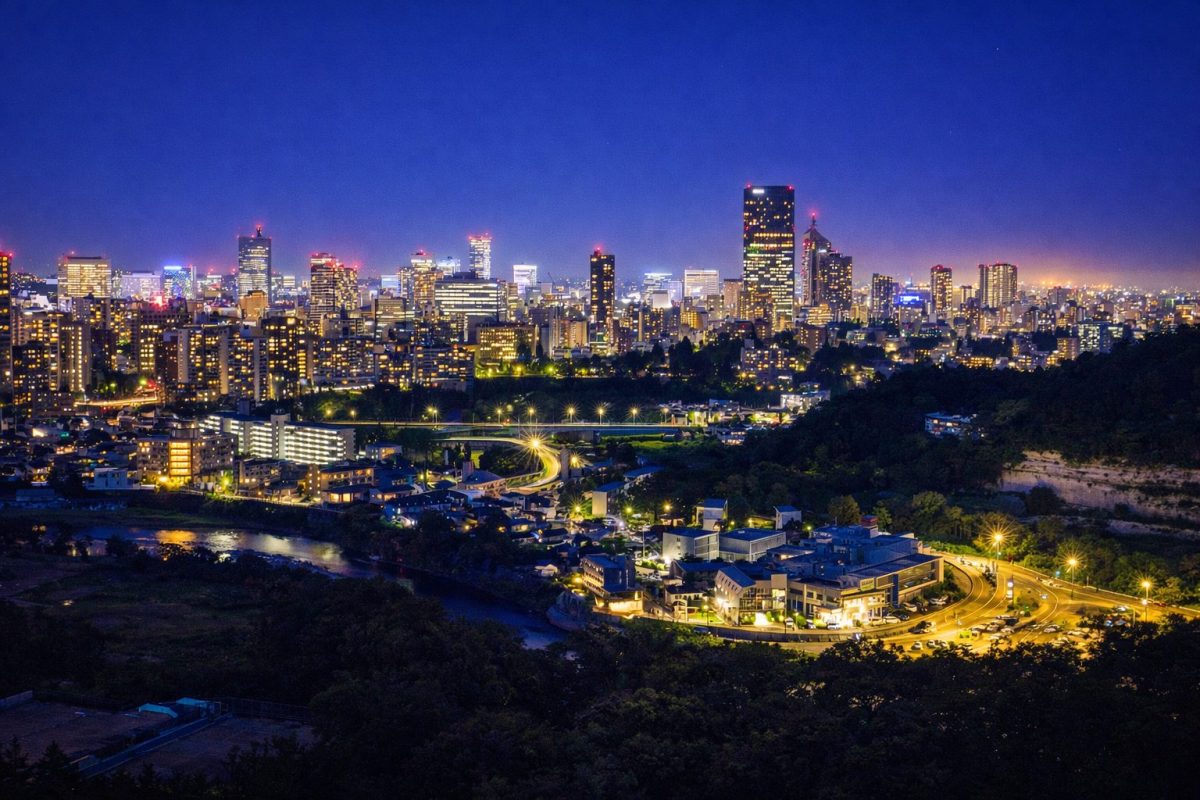
Sendai City, located almost in the center of Miyagi Prefecture, is the largest city in the Tohoku region and serves as the prefectural capital. The city stretches from east to west, with the Ou Mountains rising to the west and the coastal area along Sendai Bay to the east. Rivers such as the Hirose River and the Nanakita River flow through the city. This continuous combination of inland hills, alluvial plains, and coastal areas has created an urban structure where advanced city functions and rich natural environments coexist.
Originating as a castle town built by Date Masamune, Sendai has developed into the political, economic, academic, and transportation hub of the Tohoku region. Known today as the “City of Trees,” Sendai is characterized by its harmonious cityscape, where abundant street trees—symbolized by Jozenji-dori and Aoba-dori—blend seamlessly with urban functions. As a government-designated city with five wards, Sendai is highly regarded as a leading city that drives the entire Tohoku region in fields such as academic research, commerce, culture, and sports.
History
The history of Sendai City dates back to 1600, when Date Masamune built Sendai Castle on Mount Aoba and developed the surrounding castle town. A planned urban design was implemented, including a grid-pattern street layout and the systematic arrangement of samurai and merchant districts, allowing Sendai to flourish as one of the leading castle towns in the Tohoku region. Throughout the Edo period, it served as the political, economic, and cultural center of the 620,000-koku Sendai Domain and prospered as a key hub along the Oshu Kaido, attracting people and goods.
After the Meiji Restoration, Sendai underwent modernization as the prefectural capital, with railway development and the concentration of government offices establishing its position as the core city of the Tohoku region. Following World War II, postwar reconstruction plans led to the development of wide roads and parks. In 1989, Sendai became a government-designated city. With further advancements such as the opening of the Tozai Subway Line in 2015, urban functions have continued to evolve, and Sendai remains a central city supporting the Tohoku region.
Culture and Customs
Sendai’s culture is rooted in Date culture while also incorporating layers of academic, artistic, and civic traditions. Cultural facilities such as Sendai Mediatheque and Sendai City Museum serve as hubs for the dissemination of contemporary art, literature, and historical culture.
Citizen-led cultural activities are also highly active. Events such as the Jozenji Street Jazz Festival and participatory performing arts programs transform the entire city into a cultural stage. Traditional events centered around Zuihoden Mausoleum, where Date Masamune is enshrined, and Osaki Hachimangu Shrine continue to be passed down, creating a unique urban culture where history and contemporary life coexist.
Local Specialties
-
Gyutan (Grilled Beef Tongue):
A food culture that originated in Sendai and is now known nationwide. Created after World War II, gyutan is enjoyed by both tourists and local residents, with many specialty restaurants located throughout the city.
View gyutan restaurant locations -
Sasa Kamaboko:
A fish cake product made from locally caught fish. It has become a popular souvenir, with manufacturing and direct-sales facilities scattered around the city.
Find sasa kamaboko shops -
Sendai Miso:
A red miso said to have been promoted during the era of Date Masamune. It is relatively high in salt content and well suited for long-term storage.
Sendai miso-related facilities -
Zunda Mochi:
A traditional local sweet made with “zunda,” a paste of mashed edamame. It is widely sold at Japanese confectionery shops and souvenir stores.
Find zunda mochi
Relocation and Living Information
- Daily Convenience: Commercial facilities, medical institutions, and government offices are concentrated around Sendai Station and the centers of each ward. The well-developed public transportation network makes car-free living possible.
- Child-Rearing Environment: A wide range of childcare facilities and schools are available, supported by comprehensive child-rearing assistance programs. Parks and natural environments are also close at hand.
- Medical Care: Advanced medical institutions are concentrated in the city, including Tohoku University Hospital.
- Housing: Diverse residential areas extend from the city center to the suburbs, offering many options for both condominiums and detached houses.
Climate and Living Environment
- Pacific-side climate with relatively little snowfall.
- Summers are relatively mild compared to other parts of the Tohoku region.
- Sea breezes and mountain winds help moderate temperatures.
Characteristics by Area (Ward Overview)
- Aoba Ward: The administrative, economic, and cultural core of Sendai, encompassing the downtown area around Sendai City Hall, Miyagi Prefectural Government Office, and Sendai Station. Areas such as Ichibancho, Chuo-dori, and Kokubuncho form the largest commercial and entertainment district in the Tohoku region. The area around Tohoku University Kawauchi Campus and Mount Aoba is home to many academic and research institutions, symbolizing “Sendai, the City of Learning.” The western part is mountainous and includes tourist destinations such as Sakunami Onsen.
- Miyagino Ward: This ward includes the east exit of Sendai Station and has seen significant redevelopment in recent years. Centered around Rakuten Mobile Park Miyagi, sports and entertainment functions related to professional baseball are concentrated here. The eastern area features the coastal industrial and logistics zone around Sendai Port, with industrial parks and distribution hubs. The ward plays a vital role in supporting Sendai’s industrial base, with a mix of residential, commercial, and industrial areas.
- Wakabayashi Ward: Located in the southeastern part of the city, this area combines traditional downtown-style neighborhoods with newly developed residential zones. Around Arai Station, urban development has progressed following the opening of the Tozai Subway Line, improving housing supply and daily convenience. Farmland still remains in parts of the ward, offering agricultural landscapes within an urban setting. After the Great East Japan Earthquake, disaster-prevention group relocation and reconstruction public housing projects were implemented, making the ward a key area for recovery and rebuilding.
- Taihakui Ward: Serving as the southern hub of Sendai, the areas around Nagamachi Station and Nagamachi-Minami Station have developed as a sub-city center. Large commercial facilities, public institutions, and residential towers are concentrated here, playing an important role in decentralizing urban functions. The southwestern area includes Akiu Onsen and mountainous terrain, creating a continuous structure linking the city, nature, and tourism. The ward is popular as a residential area, particularly among families with children.
- Izumi Ward: Centered on the former Izumi City area, this northern ward is known as a planned residential city. Around Izumi-Chuo Station, administrative offices, commercial facilities, and offices are concentrated, forming a wide-area urban hub. Large-scale new towns such as Izumi Park Town provide a high-quality living environment. At the same time, the northern area retains many hills and green spaces, achieving a balance between urban life and natural surroundings.
Access
- Rail: Sendai is the largest railway hub in the Tohoku region, with Sendai Station serving as the central node for Shinkansen, conventional railways, and subways. The Tohoku Shinkansen connects Sendai to Tokyo in as little as about 1 hour and 30 minutes. The Akita Shinkansen and Hokkaido Shinkansen (direct services north of Morioka) are also accessible. JR conventional lines such as the Tohoku Main Line, Joban Line, Senzan Line, and Senseki Line extend radially, supporting commuting, schooling, and regional travel. Within the city, the Sendai Subway Namboku Line and Tozai Line operate, connecting the city center with Izumi-Chuo, Nagamachi, sub-centers, and coastal areas, forming a public-transport-oriented urban structure.
- Air: Sendai Airport is located across Natori City and Iwanuma City and functions as a city-proximate airport, accessible from Sendai Station in about 17 minutes by the Sendai Airport Access Line rapid service. In addition to domestic flights to major cities such as Sapporo, Nagoya, Osaka, Fukuoka, and Naha, international flights operate to destinations including Seoul, Taipei, and Shanghai, making it the aerial gateway to the Tohoku region.
- Roads: Major expressways such as the Tohoku Expressway, Sanriku Expressway, and Sendai Nambu Road run through the city, forming an urban ring expressway network. National Routes 4, 45, 48, and 286 are also well developed, contributing to smooth logistics and transportation within and beyond the prefecture.
- Bus: Sendai City Bus and Miyagi Kotsu operate services covering the entire city, complementing rail networks in areas without stations. Numerous highway buses depart from the area around Sendai Station, providing convenient access to Yamagata, Fukushima, Morioka, and the Tokyo metropolitan area.
Tourist Attractions
- Sendai Castle Ruins (Aoba Castle Ruins) The remains of the castle built by Date Masamune, located on a hill overlooking the city. Stone walls and reconstructed turrets remain, and the equestrian statue of Date Masamune is one of Sendai’s iconic landmarks. The site is also popular for its night views.
- Jozenji-dori Avenue A representative urban landscape of Sendai lined with zelkova trees and selected as one of Japan’s “100 Best Roads.” Seasonal scenery can be enjoyed year-round, hosting events such as the Jozenji Street Jazz Festival in summer and the SENDAI Pageant of Starlight in winter.
- Zuihoden Mausoleum The mausoleum of Date Masamune, known for its lavish Momoyama-style decorations. Surrounded by cedar forests, it offers visitors an immersive experience of the history and aesthetics of the Date clan.
- Osaki Hachimangu Shrine A National Treasure featuring Momoyama-style architecture and revered as the guardian shrine of Sendai. Many worshippers visit throughout the year, especially during New Year’s and the Donto Festival.
- Akiu Onsen A hot spring resort located about 30 minutes by car from the city center, historically known as the “Hot Springs of Natori.” In addition to accommodation facilities, nearby scenic spots such as Akiu Great Falls make it a popular urban-adjacent tourist destination.
- Sendai Mediatheque A cultural complex designed by architect Toyo Ito, serving as a hub for libraries, art exhibitions, and visual media. It is internationally recognized as a center where contemporary architecture and civic culture converge.